

THE FUTURE WE WANT: SDGs and INDIA
- Gitika Mahawar
- Jun 17, 2021
- 6 min read
“Development which meets the needs of the present without compromising the ability of future generations to meet their own needs”
- Brundtland Commission, Our Common Future (1987)
Pre-1992, the paramount goal of the nation was GDP growth and that was considered synonymous with national development. However, in 2015, all United Nations Member States approved the Sustainable Development Goals (SDGs)suggested in the 2030 Agenda for Sustainable Development; a global call to action to eradicate poverty, safeguard the environment, and guarantee that all people achieve peace and prosperity by 2030.
Built on the success of the Millennium Development Goals (MDGs), the SDGs hope to further facilitate the eradication of poverty. The new Goals are unusual in that they call on all countries, rich and poor, to create prosperity while also conserving the environment. They acknowledge that eradicating poverty requires policies that promote economic growth while also addressing a variety of social needs such as education, health, social protection, and employment opportunities while keeping both global warming and environmental protection in mind. A list of 169 SDG targets describes the 17 SDGs. In addition, 232 different indicators have been agreed upon to measure progress toward these Goals.
Economic growth, social inclusion, and environmental preservation are the three pillars of sustainable development. Harmonising them is critical. Sustainable development requires long-term economic growth, stable livelihoods, living in harmony with the environment, and the use of suitable technology.

EVOLUTION:
Since the 1992 United Nations Conference on Environment and Development, often known as the Earth Summit, in Rio de Janeiro, Brazil, the world has recognised a new route to human well-being: sustainable development. Agenda 21's ideaof sustainable development understood that economic growth must be balanced with the needs of current generations while also protecting the environment, without risking future generations' capacity to fulfil their own needs.
Recognising the MDGs' achievements(More than one billion people have been lifted out of severe poverty, hunger has been reduced, more girls have been able to attend school than ever before, and our planet has been protected)[1],governments of number of countries decided to form an open working group to produce a set of sustainable development objectives for consideration and action in “The Future We Want,” the conclusion document of the UN Conference on Sustainable Development (Rio+20) in 2012. The Open Working Group's proposed SDGs are the outcome of a transparent, participatory process that included all stakeholders and people's perspectives.
Many stakeholders, particularly the youth, were active from the start on social media and other platforms, such as the UN's global ‘My World’ poll, which received more than 8 million votes from around the world, with over 75% of participants under the age of 30. The SDGs reflect an unprecedented consensus among 193 Member States on how sustainable development could be carried out , a vision supported by civil society, industry, politicians, and other players all around the globe. As a result, countries would create and implement policies in accordance with the common global goals and ambitions.

INDIA & the SDGs
According to NITI Aayog's SDG India Index 2020-21, India's drive toward fulfilling Sustainable Development Goals (SDGs) with a focus on renewable energy, urban development, and national health shot up its overall SDG score from 60 in 2019 to 66 in 2021. Aside from the SDGs for poverty and hunger elimination, indicators relating to inexpensive and clean energy, in particular, improved in various States and Union Territories like Kerala, Himachal Pradesh, Tamil Nadu and Sikkim.
One of the notable achievements of SDG’s is that clean sources of energy have been made available to families across the nation. While this is encouraging, the Index indicates that, in addition to respectable jobs and economic development, there has been a significant drop in the areas of industry, innovation, and infrastructure. These gaps have been exacerbated by government-imposed lockdowns to combat the COVID-19 pandemic.
However, the dramatic discrepancies in SDG performance across the country, with the southern and western states on the one hand and the north-central and eastern states on the other, hint at persistent socio-economic and governance gaps. If left untreated, these will worsen federal issues and lead to disastrous consequences, as seen by the public health difficulties faced by some of the worst-off states during the second COVID-19 wave.
Despite the improvement in significant metrics, the Index has made several methodological adjustments that make comparisons with past progress meaningless. Although the SDG tackling inequality has improved since 2019, the indicators used to calculate the score have changed. The 2020-21 Index downgrades numerous economic indicators, instead favouring social equality indicators, including women's and marginalised community representation in legislatures and local government institutions, as well as crimes against SC/ST populations. While this is a beneficial change, it hinders the nation’s ability to track its progress or achievements in any helpful way.
The SDG score on inequality appears to ignore the impact of the pandemic on wealth inequality by omitting the well-known Gini coefficient measure (This coefficient measures incomes disparities). It also disregarded the growth rate for household expenditure per capita among 40% of rural and urban populations (instead using only the percentage of the population in the lowest two wealth quintiles ). This might be a major oversight, given how a UN evaluation of COVID-19's effects predicted increased inequality in the South Asian area.
Other SDGs have had methodological concerns, but the lack of appropriate assessment of economic inequality appears to be a glaring omission. The second wave, which has caused more fatalities than the first, has had comparable effects on lives and jobs. Thus, while India's improved SDGs performance is encouraging; the Government must seek to address significant concerns such as rising inequality and economic pessimism.
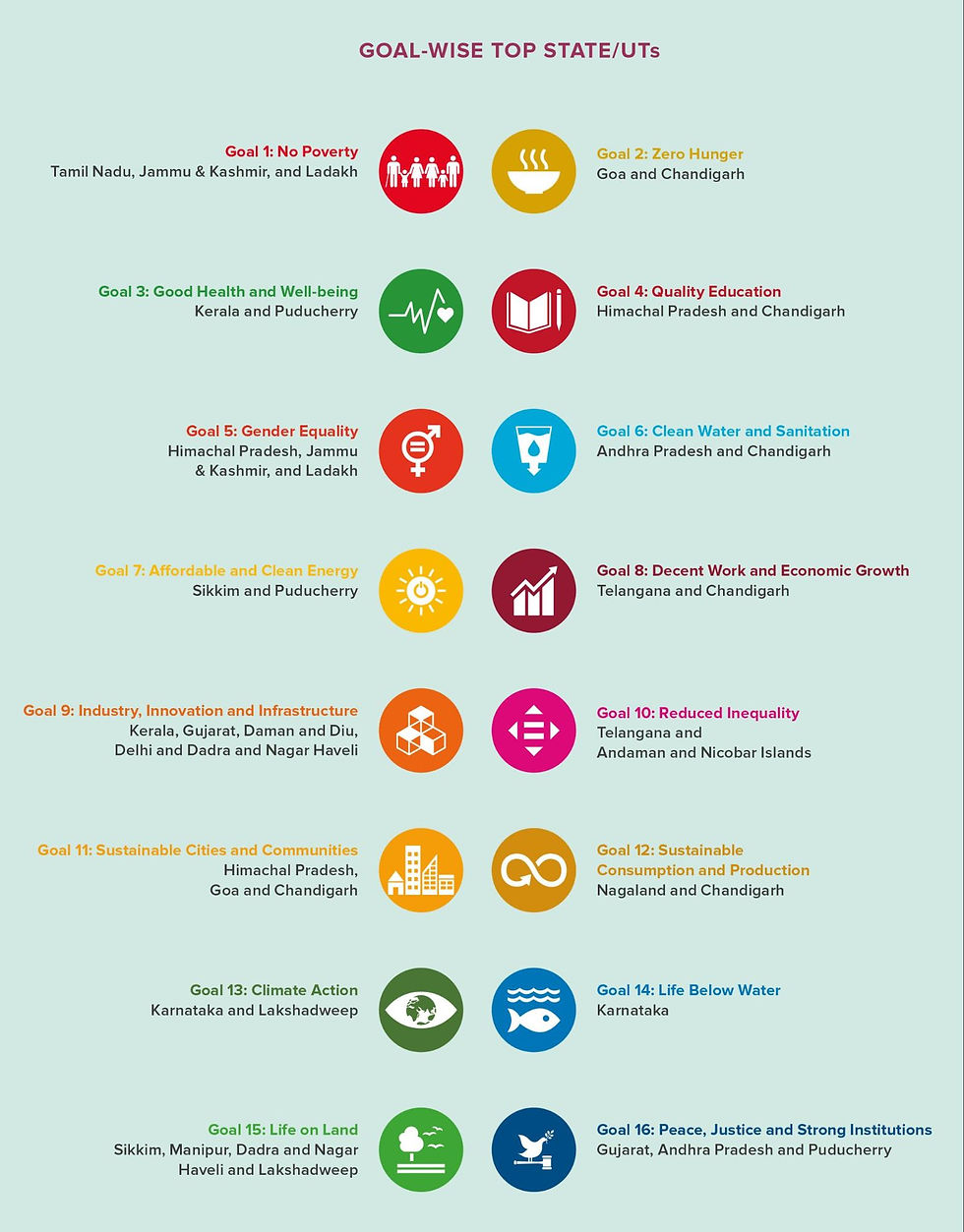
SGD INDEX 2021 & KEY POINTS
With regards to the 17 Sustainable Development Goals (SDGs) announced as part of the 2030 agenda. India has dropped two positions, to 117. The State of India’s Environment Report 2021 revealed that India’s rank was 115 last year. The drop was primarily because major challenges like:
· ending hunger and achieving food security (SDG 2)
· achieving gender equality (SDG 5)
· building resilient infrastructure, promoting inclusive and sustainable industrialisation and fostering innovation (SDG 9) persist in the country.
According to the report, India is ranked behind four South Asian countries: Bhutan, Nepal, Sri Lanka, and Bangladesh. India's total SDG score is 61.9 out of 100. Jharkhand and Bihar are the least equipped states to fulfil the SDGs by 2030, the goal year. While Jharkhand is behind on five of the SDGs, Bihar is behind on seven. According to the report, Kerala, Himachal Pradesh, and Chandigarh have the greatest overall scores and are on track to meet the SDGs. All UN Member States endorsed the 2030 Agenda for Sustainable Development in 2015, which provides a shared roadmap for peace and prosperity for people and the planet today and in the future.
According to the report, India was ranked 168 out of 180 countries in terms of the Environmental Performance Index (EPI), which is based on several factors, such as environmental health, climate, air pollution, sanitation and drinking water, ecosystem services, biodiversity, etc. . India was ranked 172 in the environmental health category, which measures how well countries protect their environment.
According to Yale University's EPI 2020 report[2], India was rated 148th, 21 places behind Pakistan, which placed 127th in biodiversity and habitat, which evaluates nations' efforts to preserve natural ecosystems and safeguard the whole spectrum of species within their boundaries.
Conclusion
Environmental, economic, and political challenges are all linked by how humans interact with their environments and with one another. We prosper because the ecosystem provides us with a diverse range of opportunities. The global concern for the protection of natural and environmental resources, as well as the quest for so-called sustainable growth, has resulted in the development of research aimed at understanding the effects, causes, and critical implications of environmental degradation, as well as research into associated potential solutions.
In order to improve the SDG rankings, the Government should ensure that its own employees are transparent, i.e., by reducing corruption. The Government should emphasise the importance of universal education. With the assistance of the judiciary, the Government must strive to provide speedy justice to poor people who are often deprived of their rights. Until the poor recognise their rights, they will not be protected in society. The massive backlog of unsolved and even unheard cases is a significant roadblock for the legal system.
The Indian Government has adopted the idea of Gram Nyayalas, or door-to-door judicial assistance, but it is narrow in scope and unable to achieve its objectives. The concept of free legal assistance is no longer free. This must be reversed, or India will remain on the list of emerging countries. Thus, we must keep in mind that eradicating poverty is not an act of charity, but rather an act of justice.
Owing to the holistic character of the SDG framework, policymakers must examine a significant number of possible connections across the 169 objectives. The interdependencies between the objectives, both across and within the SDGs, must be analysed in order for policy to be implemented. This problem is not new, and similar concerns have been raised in the past when attempting to align climate change adaptation and mitigation efforts with poverty reduction, achievement of the Millennium Development Goals (MDGs), and balancing economic development, environmental sustainability, and social inclusion for human well-being
[1] “Were the Millennium Development Goals a Success? Yes! Sort Of.” Article | World Vision International, www.wvi.org/united-nations-and-global-engagement/article/were-mdgs-success
[2] “Environmental Performance Index | Environmental Performance Index.” Https://Epi.Yale.Edu/, Yale University, epi.yale.edu/epi-results/2020/component/epi.


👏👏