
The Paradox of Gandhian Feminism
- Saurabh Samraat
- Oct 2, 2021
- 6 min read
Updated: Oct 4, 2021

Gandhian feminism isn't a new concept. It is well-known how Gandhi has inspired the women of a whole generation to reclaim their significance in society while also finding themselves in the process. Contrary to this, we find Mahatma Gandhi using exceptionally inappropriate language while discussing women or feminine qualities over the course of his works. Upon a closer look, we will see this immense disparity taking place in the Gandhian narrative. As tremendous a figure as Gandhi was, there undoubtedly had to be ramifications of such a disparity that transcended its colonial beginnings and has spread its tendrils into present-day India. In the spirit of the Gandhian notion of asking questions, this Gandhi Jayanti, I would like to question his version of feminism through this article.
The rejection of western civilisation and the re-visitation to our own traditional ways of living that Gandhi propagated couldn't have been made possible without the active and voluntary participation of women; the glue that kept the ways of our old civilisation together by holding the administrative reigns of the institutions of family, cultural and social life. They were also the ones who had faced the heat of several social evils of the old civilisation such as child marriage, sati system, oppression of widows, purdah system, denial of the property rights, etc. This important role played by women made them key players for the implementation of Gandhian thought. That was why Gandhi believed that the empowerment of women could lead to the collective empowerment of the whole nation. It is evident from the speech he gave at the All-India Women's Conference in 1936, where he said: "When woman, whom we call abala becomes sabala, all those who are helpless will become powerful". Gandhi understood this significance of women and made nationalist appeals for gender solidarity and equality which should start from home and span to the society at large as he knew that without the dynamic support of women in the social, cultural and political fields of India, the idea of Swaraj would be a mere myth. This appeal became the foundation of widescale women's participation in the freedom struggle, which furthered the Gandhian agenda of peace and non-violence. He incorporated women in his nationalistic struggles such as the salt march, the non-cooperation movement and the swadeshi movement to provide a leading example of women's inclusion and gender equality.

Despite the fact that Gandhi aimed to create a society based on what Kiran Saxena calls "feminine values" through satyagraha and advocated for a "feminist strategy" to achieve that aim, his language through his numerous writings when viewed through the prism of today's feminism can be deemed fundamentally derogatory to women. One such problematic usage of language is clearly evident in his landmark work, Hind Swaraj. While criticizing the British Parliament, he compares it to a prostitute and a sterile woman. His language doesn't only disparage those women who employ themselves as prostitutes, it also establishes that the sole motive of a woman's existence is to reproduce or else she'll be deemed useless. Another derogatory utilization of language is apparent when Gandhi uses the words “unmanly” or “effeminate” throughout the book. They exhibit archaic gender stereotypes which suggest that if anything doesn't conform to the stereotypical or Gandhian definition of masculinity, it must be deemed “unmasculine” and thus is an inferior quality to possess. Conversely, this usage denotes the noble qualities of truthfulness, courage, righteousness and nobility to be “man-like”, depriving femininity of those positive attributions. This hazardous use of language gives fuel to the fire of the already prevalent sexual division of labour and sexism as it deems women inferior to men and is in contrast with the notion of equality that Gandhi talked about when he said "men and women are of equal rank".
It is clear now that while Gandhian feminism demanded the respect for women that they deserved, the language used by Gandhi stripped the feminine sphere of its dignity. To understand this disparity, we will have to understand the underlying cause. At the 1919 Women Assembly of Bombay, Gandhi stated, "The swadeshi vow too cannot be kept fully if women do not help. Men alone will be able to do nothing in the matter. They can have no control over the children; that is the woman's sphere. To look after children, to dress them, is the mother's duty. Therefore, it is necessary that women should be fired with the spirit of swadeshi." Through this, we see a glimpse of the gender stereotypes buried inside the mind of Gandhi. Gandhi also referred to Sita as the ideal spouse and thereby a leading example for women instead of Rani Lakshmibai. While on the one hand, the figure of Lakshmibai connoted women's freedom and power, Sita's example glorified the quality of sacrifice made by women on the other. It seems as if Gandhi is saying that if Sita can make sacrifices for her husband, kids, family and kingdom; Indian women should also be ready to make sacrifices for their nation. Additionally, Rita Banerji shows that Gandhi looked down upon menstruation; a normal biological function of a woman's body and viewed it as the "distortion of a woman's soul by her sexuality.” According to, his advocacy for widow remarriage was also not completely devoted to women's emancipation, rather it could have been guided by his extreme repulsion to nonmarital sexual intercourse. According to him, it's better if a widow is "married openly" rather than she "sins secretly". His reference to prostitutes as 'fallen women' and his attitude towards rape further displays how his mindset was still rooted in the patriarchy, the by-product of which was his usage of derogatory language towards women.
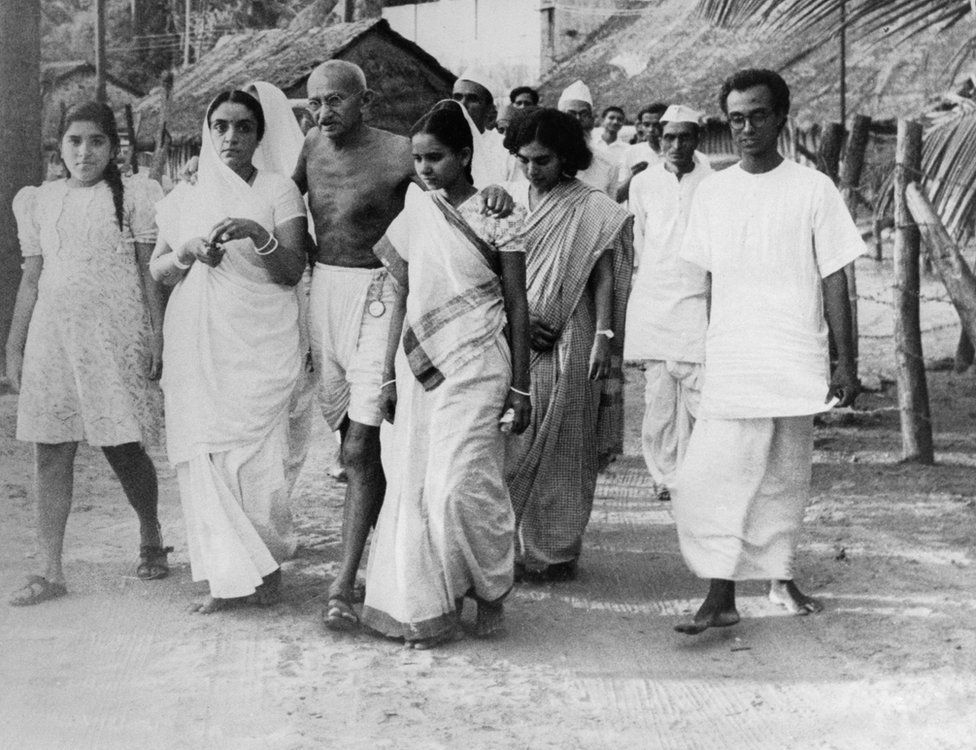
Owing to Gandhi's elephantine political stature, the narrative of the freedom struggle set by Gandhi defined the course of post-colonial India and it is certain that the misogynist language and paradoxical approach taken by him towards women had implications not only in colonised India but still continues to affect women's lives nationwide. This is clearly evident if we refer to the number of women in comparison to men in the first Lok Sabha or even in today's parliament or other male-dominated spheres. Apart from this, although the vague concepts of the superiority of women prevail in India while we pray to a thousand different goddesses, women aren't given absolute agency even over their own body or life. This type of conservative approach stands at par with the Gandhian narrative on women. He once said;
Men and women are of equal rank, but they are not identical. They are a peerless peer, being supplementary to one another; each helps the other so that without the one, the essence of the other cannot be conceived…. Man is the supreme in the outward activities of a married pair and therefore, it is in the fitness of things that he should have a greater knowledge therefore. On the other hand, home life is entirely in the sphere of women, and, therefore, in domestic affairs, in the upbringing and education of children, women ought to have more knowledge.
These stereotypes propagated by Gandhi validated and thus reproduced the already existing discriminatory norms of our society, resulting in a number of social evils. The pervasiveness of victim-blaming could also be related to Gandhi's approach towards rape victims, whom he suggested to die in self-defence as he believed that "fearless woman, who knows that her purity is her best shield can never be dishonoured."

While on the one hand the dhoti-clad, non-violent satyagrahi Gandhi is known for his progressive firsts in many areas of humankind, even in the arena of feminism as he led the outcry for women's inclusion in society resulting in women's liberation and participation in the freedom struggle, the language he used in his speeches and literary-political works points us to Gandhi's traditional and borderline chauvinistic approach towards women and femininity, especially if we view it through today's prism. Liberation from colonialism can be attributed to Gandhi but the patriarchal narrative set by Gandhi still continues to pervade the lives of women in a restrictive fashion. This disparity led to various implications that are still disrupting the lives of Indian women. While it cannot be denied that everyone in India today owes a significant part of their freedom to Gandhi, I truly believe that Gandhian inquisition should be applied to Gandhi himself. This Gandhi Jayanti, let’s hope the past mistakes of our great leaders inspire us to write our future in the same way as their idealism inspires us to.


Comments